Break Even Point: What Is It And How To Calculate it?
Learn how to use the break even point to determine when you start making a profit.


Every entrepreneur wants to know when the company starts to generate profits, right?
This mission is not simple, but the good news is that there is an indicator that helps us understand what the minimum billing should be for this to happen.
This indicator is the break even point (BEP), and to learn how to calculate it and identify the exact point at which your revenue exceeds costs, continue reading this article.
What is Break Even Point?
Break even point is a term widely used in economics and finance to indicate the financial equilibrium of an organization. That is, it is the moment when you have no loss but you also have no profit.
Break-even is the point at which revenue equals costs over the same period of time. With this indicator, it is possible to know the minimum billing that one must have so that the company can cover its expenses.
How to interpret the BEP?
In the following chart the vertical axis represents the financial value, and the horizontal represents the volume of products. Graphically, the BEP is represented as the intersection of the revenue and cost lines.
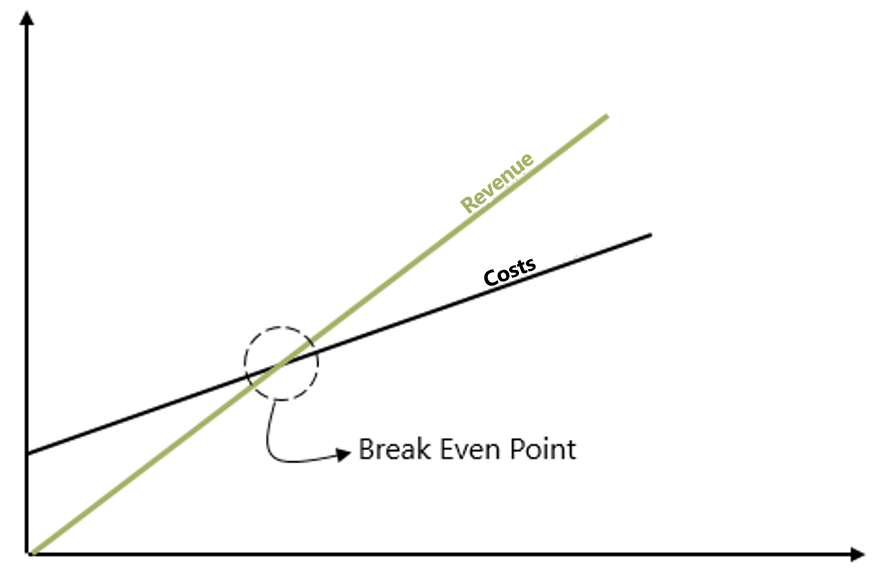
It can be observed that the revenue stream starts at the origin, and generates cash flow to the company based on sales volume.
The cost line is not initiated at the origin of the graph, due to the fact that even before a single product is produced, the company already has expenses involved and, therefore, this line is initiated in the value of fixed costs of the process.
In addition, costs are also increasing as the volume of products produced increases. However, this growth occurs at a lower rate than the growth of the other line, thus generating the intersection between them.
This intersection represents the exact point at which the revenue generated by the sales equals the cost of production (fixed and variable costs). And that's where we find out what the minimum billing the company must have to cover its expenses and start generating cash.
We can also observe that below the break even point, we have revenue smaller than cost, that is, there is a loss. And analogously to this thought, above this point we have revenue higher than costs, and so we have a profit.
We must always aim to be above that point, and for this we will learn to find it.
It's time for you to start your training in one of the most valued methodologies on the market!
With our Green Belt training in Lean Six Sigma, you will develop fundamental skills and knowledge for your professional growth!
Our teaching methodology has content such as videos, exercises, complementary readings and personal assistance, so you can take the next step towards Green Belt professional recognition in Lean Six Sigma.
Don't waste time and reach the next level in your professional career!

Calculating the break even point
You may have noticed a little deeper terms in the course of this article, right? So, before explaining how to calculate this important point of equilibrium let's define some concepts.
Fixed costs
Fixed costs and expenses are those that are independent of the quantity produced. As its name already says, are costs that do not vary with production. Payroll, rent and taxes are examples of fixed costs.
Variable costs
Variable costs are those that change according to production, are the costs directly linked to producing a product or performing a service. Supplies and material costs are examples of variable costs.
Sales
The sale is the basis of the operations of the companies, through which the company obtains cash flow. For our calculation in question should be considered the sum of all sales of the company.
Contribution margin
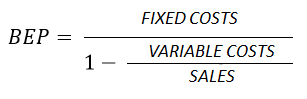
A contribution margin is the residual value of the sale of a product by discounting variable costs. This margin is necessary to define how much each product needs to receive to cover fixed costs.
Now that we know these concepts, you just have to apply the following equation to calculate the financial break-even point.
Practical example
How about calculating the break even point for Voitto Tech? This company wants to sell 1,000 units of a given product at $ 99.90. To produce a unit of this product we have $ 22.00 in variable costs, in addition to a fixed cost of around $ 4,900.00.
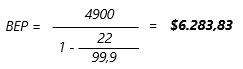
We obtain, therefore, that a minimum revenue of $ 6,283.83 is necessary in order for Voitto Tech to start making a profit.
Understand the main tools of this methodology and know how to apply it with excellence to increase productivity!
With this eBook The main tools of Lean Six Sigma you will understand the concept of Six Sigma, as well as a compilation of the main tools used by Belts in the application of each step of the DMAIC method.
These tools will help you to define, measure, analyze and propose solutions to problems that affect the performance of your company's organizational processes.
In this material, in addition to obtaining the definition of each of these tools, what they are used for, and how to use them, you will also find application tips using the Minitab software. So don't waste your time and download now!