What is a Check Sheet? Know about this quality tool!
This guide helps you to know about the check sheet, a simple quality tool that can increase your results.


It is very likely that you have already heard the following phrase: "You are not going to war without knowing the enemy", right? Well, that phrase fits very well when it comes to the check sheet and you'll understand the reason in this guide.
To improve quality it is necessary to have a reliable database. By analyzing this information you can try to find the root cause of the production problem and improve it.
In order to succeed in this process we need some quality tools. However, I will speak specifically about the check sheet.
So pay close attention because this article will bring you all you need to know about this tool and you'll see just how important it is to improving the process.
What is a Check Sheet?
Check Sheet is the simplest quality tool. Basically it aims to standardize and organize the collection of data. This collection may be through tables, worksheets or tables.
With this sheet the responsible person goes to Gemba to be able to understand the operation of the activities to verify where the problem is and to collect the data to identify the root cause of the problem.
Surely you are wondering, "What is Gemba?" It is nothing more than a Japanese term used to represent the "real place" where the whole process takes place.
This term is similar to the Genchi Genbutsu expression "Go See", that is, go to the place where the problem is happening, collect data and make a decision to resolve it.
To go to Gemba you have to go with a clinical eye, so you can really find where the opportunities for improvement in production are.
Therefore, to aid in this whole process, there are the check sheets. They already come with a ready format with just the information needed to save time. More time you save, the better it is!
It is important to note that there are 3 main types of check sheet and the choice of each one depends according to the purpose of the data collection.
Lean Six Sigma is a methodology that seeks to increase the profitability of companies through the improvement of their processes.
Thinking about you and your career, we, at Think Lean Six Sigma, created a FREE Yellow Belt training in Lean Six Sigma.In this training, we will introduce you to the DMAIC method and all its 5 steps, namely: "Define, Measure, Analyze, Improve and Control.
With this course, you will be able to develop small improvement projects within your area of expertise and work with Green Belts and Black Belts in support of the Lean Six Sigma program.
Have you ever thought about being the agent of change within your organization? Click on the image below for more information and become a Yellow Belt, for FREE!

What are the Check Sheet types? See Check Sheet Examples!
1 - Check sheet for the analysis of the distribution of a control item
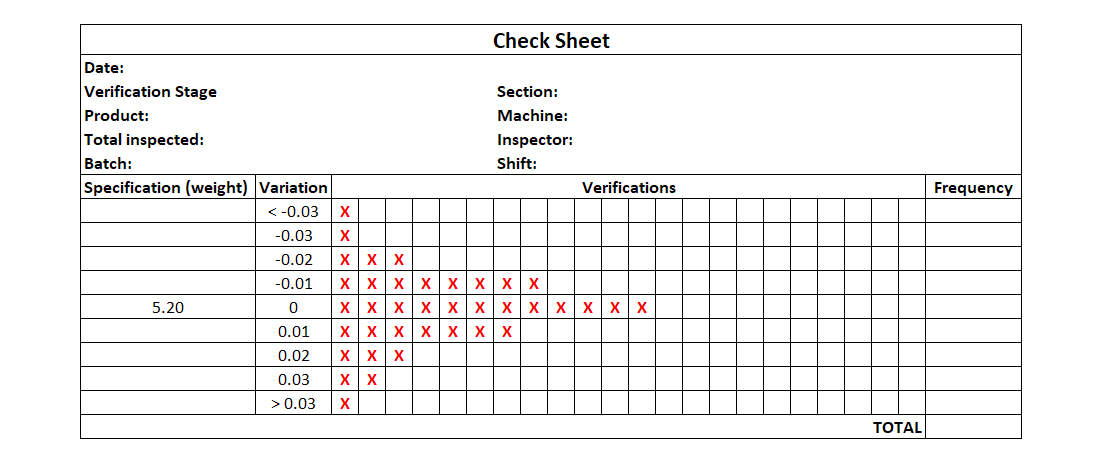
This first type of sheet is used when you want to know and analyze the distribution of the values of a control item or an interest item associated with a particular process.
What is the composition of it and how should it be fulfilled? First of all, in the header of the sheet you should put the data and information about the process, such as the date, time, stage, product and total inspection.
At the bottom of the sheet, there are columns that should be filled with the specifications of the weights and their variations. Really simple, right?
With these variations you can see where the greatest incidence of problems in the process is occurring and whether it is producing below or above the average.
Interesting, but what is the result of this check sheet? As a result of it we have another quality tool, the histogram. The curve generated in this tool is the same as that shown on the sheet. The largest column shows the biggest trend.
2 - Defective Items Check Sheet
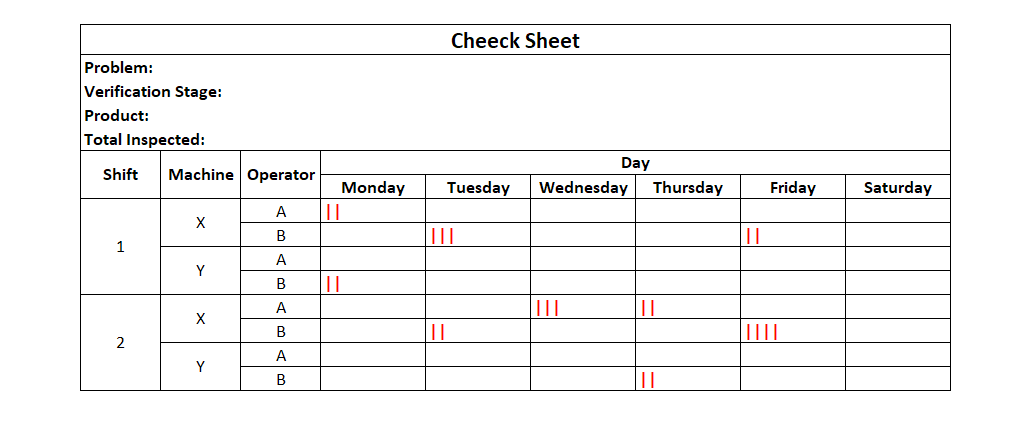
This second sheet is basically used when you want to know what types of defects are most frequent and the number of times the cause occurs.
It has to do the same thing as I said on the previous sheet. It is extremely necessary to put all the information in the header so that you have control of the whole production process.
The use of this sheet is crucial for the management and development of production. Because it can identify the number of defects and what they are, no matter what it is. As a result of this check sheet you have information for building another quality tool, the Pareto chart.
Oh cool, but how does this chart help in this process? With it you can identify where the greatest concentration of defects is, so you can correct them.
In addition, the results obtained in the data collection, as in the first type of sheet, can generate a histogram for better visualization of the results.
3 - Defect Causes Identification Check Sheet
It is used to relate causes to effects. The data of the causes are arranged in such a way that they are easily related to the effects, making it easier and clearer to investigate the defects observed within a given process.
Maybe you can get confused and think that sheets 2 and 3 are the same thing. But you're wrong.
This sheet has paper to pick up the defects identified by the previous sheet and to look for the cause of these defects.
6 Tips for Using the Check Sheet
1. Set Your Goals
The first of these is that you have to establish exactly which event is being studied and set the goals of your data collection.
Well imagine this situation: you are doing a search but you did not plan correctly for the collection of this data. With this, you will have energy, people and time expenditures that in the end will serve no purpose.
Before taking action you should know exactly what data is needed and how it should be collected, so that you can later identify the root cause of the problem and create your check sheet.
2. Determine the type of check sheet
Determine the appropriate type of check sheet and name it according to its utility.
This is extremely important because if you do not have the correct sheet you will not have the correct data, the correct information and will have a so-called "false analysis". You can interpret that data very well but you will not know what to do with it.
3. Build a Clear Form
It is necessary to build a clear and easy-to-handle form, making sure that all columns are clearly titled and that there is enough space for the data to be recorded.
It must not forget the identification field of the person responsible for completing the sheet.
This form must be simple, in order to facilitate collection.
4. Inform the people involved in the process.
Raise awareness to all involved in the process of collecting data on the importance and purpose of this process. Instructing them as to the correct completion of the form.
You have to tell all the employees who are on the production line that a team is going to measure what they are doing.
It is also necessary to make explicit that they have complete freedom to propose ideas that are for the benefit of the company.
5. Tell how, where and when to collect
This fifth tip is crucial for the use of the check sheet. You should inform all the people involved in the process how the collection will be done, where and when.
After all, "you should not go into other people's houses without an announcement"! Every team involved in the process being analyzed must be aware that measurements will be taken and they must carry out the operations in the same way that they are carried out on a daily basis to be possible that the data collection describes the process as it really happens.
6. Make tests
Finally we come to the last tip! You need to be sure that all the stratification factors required for further analysis are present in the checklist.
In order to be able to see any failure of elaboration it is indicated that you do a pre-test before the use of the check sheet.
Anyway, for a good use of this tool, it is necessary that you follow all these tips going from step to step, making sure that everything happens in the correct way.
You shall not going to war without knowing your enemy
As I talked about in this article, before taking action to solve the problems of the process you have to do the research, collect data on the whole process, identify the best way to fight it and then take action!
Now it all makes sense doesn't it? The check sheet is the basis of the knowledge of everything. Just after the collection of the problems, you must go to war, fight against these obstacles, always seeking to extinguish them.
Leverage results with ebook the 7 Quality Tools!
With this eBook, you'll learn how to use tools that will help you improve quality in any company:
• Flowchart
• Control Letters
• Ishikawa diagram
• Check Sheet
• Histogram
• Scatter Graph
• Pareto's chart
In it, you will also find definitions of the concept of Quality in the view of today's gurus. Plus a surprise that we prepared for you. A kit with DMAIC tools, to help you even more at the time of application. Do not miss this opportunity and download this material right now.