What is a Process Map? Understand how to do it!
Learn what it is and how to make a process map, a tool increasingly used in the search for continuous improvement!


Everyone knows what a map is, don't they? It is nothing more than a graphical representation of a geographic area or part of the Earth's surface. But what about a process map? Do you know what it is?
It's the same thing, except that instead of representing a portion of Earth, it represents a certain process!
On the other hand, a process is a set of interrelated or interactive activities that transform inputs into outputs by adding value to the product or service.
Today, the process approach is widely recommended. It facilitates the identification of improvements, allows us to understand how production works, and eliminates waste by signaling steps that do not add value to what is being produced.
But calm down, even if you didn't understand very well how a process map should be, I assure you that when you finish reading this article all your doubts will be perfectly clarified!
Here, you will find what a process map means and examples to get inspired and build your own!
Want to get a taste of what's to come? So get ready because today you will learn:
- What is the Process Map?
- How can the process map help?
- When to use the Process Map?
Before we continue reading this article…
Lean Six Sigma is a methodology that seeks to increase the profitability of companies through the improvement of their processes.
Thinking about you and your career, we, at Think Lean Six Sigma, created a FREE Yellow Belt training in Lean Six Sigma.In this training, we will introduce you to the DMAIC method and all its 5 steps, namely: "Define, Measure, Analyze, Improve and Control.
With this course, you will be able to develop small improvement projects within your area of expertise and work with Green Belts and Black Belts in support of the Lean Six Sigma program.
Have you ever thought about being the agent of change within your organization? Click on the image below for more information and become a Yellow Belt, for FREE!

Now, let's get back to the subject of the article!
What is the Process Map?
The Process Map is a graphical illustration of a process. It should document how the process operates, including steps that add value and those that don't. Simple, isn't it? But powerful!
The process map is simple and of great value to document everything that is happening during the manufacturing steps. By making a mapping, it is possible to identify important points, such as:
- Steps that add and do not add value
- The main outputs of each step (product in the process)
- Main inputs/process parameters (X's)
- Main requirements of process outputs/deliveries (Y's).
How can the process map help?
A business process is made up of several steps, as well as different inputs and outputs. In the midst of so much information, you can get lost and make mistakes if there is no formal documentation of all this.
Who never forgot to do something because their head was full? It works similarly in a process!
By putting all the information in a document, such as a process map, you can calm your mind to work and focus on what is important. Another important point is that we often imagine the process in one way, and it works in another.
In addition, the process map informs the correct way to execute it, which facilitates communication between those involved, facilitates the planning of new projects, and the optimization of existing ones.
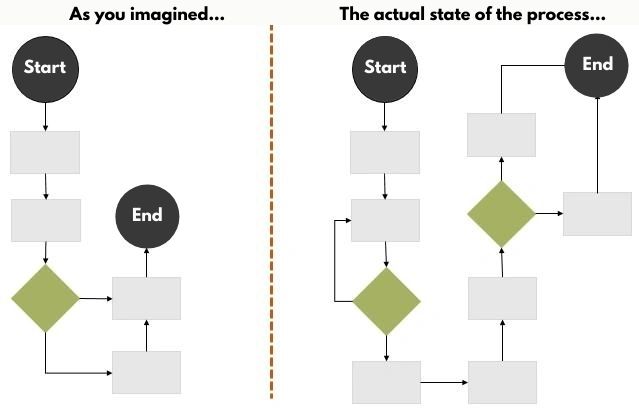
This image is a good illustration of what I'm saying. Often the person in charge thinks that things are going one way, but in reality, nothing is working as intended.
When to use the Process Map?
It is used whenever you need a quick view and a greater level of detail of the process steps.
Unlike SIPOC, the process map is made from a greater detail, where you can make decisions about each phase and the people involved.
The process map should describe its boundaries (where it starts and where it ends) and the main activities/tasks. Let's see an illustration to make it easier:

The process map must also contain the result of the process step (Product / Service in process (PP) and final product/service (PF)).
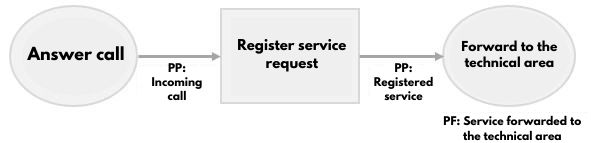
Important Parameters
To prepare a well-made Process Map, it is necessary to evaluate 4 extremely important parameters of the workflow, which are:
Final product/service parameter (capital Y): A variable that characterizes the final product/service.
Product/service-in-process parameter (lowercase y): A variable that characterizes the product/service in the intermediate stages of the process.
Process parameter (x): A process variable, considered input of the process step that can affect the result, that is, the performance of the product/service being produced.
Process Parameter Classification (x): Classify each variable as controllable or noise.
By putting together the Process Map completely, we obtain:
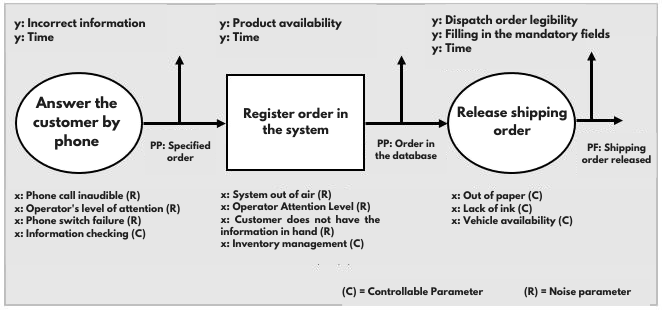
In this way, it is possible to view the detailed process as a whole, facilitating the understanding of inputs and processes, which processes can or cannot be controlled, and where improvements can be considered.
Do you understand better now how to build a process map? I hope our article has helped you!
Do you want to learn about Lean Six Sigma?
Understand the main tools of this methodology and know how to apply it with excellence to increase productivity!
With this eBook The main tools of Lean Six Sigma you will understand the concept of Six Sigma, as well as a compilation of the main tools used by Belts in the application of each step of the DMAIC method.
These tools will help you to define, measure, analyze and propose solutions to problems that affect the performance of your company's organizational processes.
In this material, in addition to obtaining the definition of each of these tools, what they are used for, and how to use them, you will also find application tips using the Minitab software. So don't waste your time and download now!