What is Voice of the Customer (VoC) in a Six Sigma Project?
What is Voice of the Customer (VoC)? This guide helps you to understand its importance in a Six Sigma Project and 4 steps to apply it.


Nowadays, competitiveness has become vital for any company. and it is extremely important to direct all your focus and professional energy in meeting your customers' wishes and desires, isn't it? For this, the Voice of the Customer (VoC) methodology has a fundamental role.
It is because of the customers that a company is still alive today in the market. If we don't listen to customers, they can meet the opposite company.
To avoid this scenario of change, one of the ways of even exceeding the expectations of these discerning buyers is through Customer Voice (VOC).
What is Voice of the Customer (VoC)?
The Voice of the Customer methodology grew along with Six Sigma and became very inviting to facilitate the identification of improvement points in a precise and efficient way, always from the point of view of who really matters: the customer.
Through the use of VoC, the Six Sigma program has the correct direction of which processes and key sectors really should obtain greater investments, both financial and qualitative. This method has made possible to relate the needs and desires of the client with the most varied processes within the organization.
In order to better understand what I am writing, I decided to list the 4 macro steps to implement the VoC and be able to interpret in a measurable way the relationship between the company's processes and variables with the expectations of its customers. Let's check it out?
It's time for you to start your training in one of the most valued methodologies on the market!
With our Green Belt training in Lean Six Sigma, you will develop fundamental skills and knowledge for your professional growth!
Our teaching methodology has content such as videos, exercises, complementary readings and personal assistance, so you can take the next step towards Green Belt professional recognition in Lean Six Sigma.
Don't waste time and reach the next level in your professional career!

How to implement Voice of the Customer (VoC) in 4 Steps
Check now 4 steps to implement the voice of the customer in a six sigma project
1. VOC: Find out how to interpret what your customer wants.
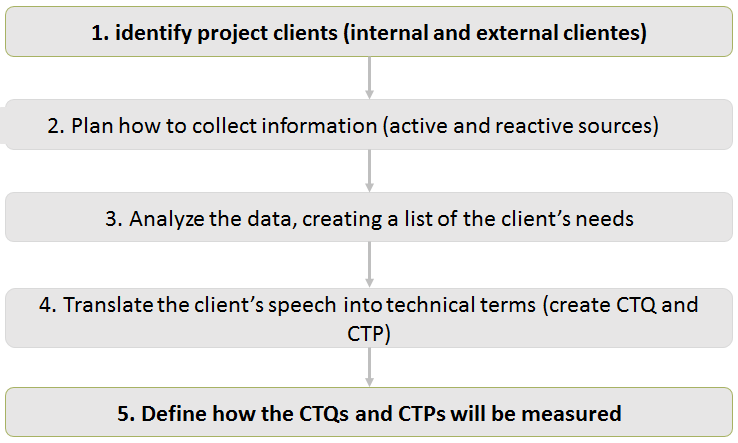
There is no mystery here: to find out what your customer wants, just ask him. This discovery must be made in the Defining step of the DMAIC method.
Information related to the sales price, quality, delivery, flexibility, and reliability can be obtained through questionnaires, meetings and interviews, satisfaction surveys and even through a simple phone call.
This information can be collected in two different ways, which are the active sources and reactive sources. But what's the difference?
- Reactive sources: this is when the information reaches you through a complaint, connection to the SAC area, or customer service through a report. Anyway, the information has already been mapped, has already been obtained through a communication channel and is already ready for you can study or analyze.
- Active sources: Unlike reactive sources, you do not have the data you need, so go collect them. It is necessary to strive to obtain the information through some research, some interview, a focus group, meetings with your client, or through direct observations.
Customers can be very vague about their needs and sometimes suggest solutions by identifying improvement points. For this reason, it is necessary to translate the client's speech into technical characteristics or business terms that will be useful to the project.
After all, as Henry Ford's celebrated phrase says: "If I asked people what they wanted, they would have said a faster horse."
Since you have collected this information, it is necessary to translate it in technical terms. For this, you need to create CTQs and CTPs. But what are CTQs and CTPs?
- CTQ (Critical to Quality): These are the critical characteristics for the quality of the product or service that can be measured. Generally, when the customer refers to the offered product or service to make some claim, he is talking about some CTQ.
- CTP (Critical to Process): These are the critical characteristics of the process. When the customer refers to the process indicating that they have some expectation or some need related to this production process or to the administrative process, it is referring to a CTP.
Just as collecting this information is important, structuring the most efficient and reliable way of collecting this data is also essential. A customer can be both external and internal. Let's see the difference?
- Internal customer: individuals or areas of the company that receives the intermediate product or service or as a finished product. They are usually able to assess process characteristics.
- External customer: individuals or organizations that consume the product or service offered by the company. They can often evaluate the characteristics of the product or service for which they have paid.
To make it easy we elaborate a step by step that you can follow in the time to execute this step based on everything that we speak here:
2. CCR: transforming needs in requirements.
Critical Customer Requirements (CCR) is a practice adopted to transform the customer requirements into design or product requirements.
Without CCR, many companies stop at the previous step and do not seek to transform their customers' needs and desires into design or product requirements.
Based only on this information, these companies make decisions, most of the time, circumstantial and optional, preventing the precise action where it really is needed.
A very useful tool at this stage is the Matrix Quality Function Deployment (QFD). It aims to list the key needs of a specific niche of customers or even just one customer and, with this, to meet the service specifications proposed by the team.
Through this tool, it is possible to quantify the relationship between needs and requirements, obtaining information on which of these solutions should actually be implemented to serve the client.
3. KPOV: confronting requirements with output variables.
While the VOC may inform that a particular customer is dissatisfied with the delivery time of its products and CCR can identify that the deadline that this customer wants their products to be shipped is up to 5 days the Key Process Output Variables (KPOV) aims to determine that the Lead Time for these products should be a maximum of 5 days.
In order to facilitate the visualization of this relation of CCR with KPOV, the SIPOC matrix is an excellent tool to help. It is possible to know all the output relationships of the process with the expectations of the clients involved.
4. KPIV: adjusting the input variables to suit your customer.
While in KPOV the final performance indicators are considered, in the Key Process Input Variables (KPIVs) are considered the input metrics. I don't know if you noticed but no improvement has been realized already, is it?
After being able to measure the relationship of the customer's needs with the requirements for service, and obtain the desired output metrics, that finally, in this last step, Lean Six Sigma projects can be deployed accurately to stimulate better performance indices on process entry. It is only acting in the process input that the end result can vary.
Do you want to learn more about Lean Six Sigma?
In this eBook you will see everything you need to know to enter the consulting market. You will learn:
• What is the role of a consultant;
• What areas of action;
• How to conduct a consulting project;
• How to price the service;
• What are the career challenges of a consultant.
Do not miss this opportunity and download this incredible material right now.