What is 5W2H? Discover this revolutionary tool
See what 5W2H is, how to effectively interpret a problem, understand your decision-making process and create your model.


One of the Lean Six Sigma foundations is to make decisions based on facts and data that accurately indicate the best path to take. Do you know what 5W2H is?
5W2H is one of the tools used by companies that have competitive advantage, since it is based on the premise that there is nothing so good that it cannot be improved. Thus, using it, along with other strategies, is a great way to promote a culture of continuous improvement and make decisions more assertive.
5W2H is also a great option for companies that want to improve strategic planning in order to achieve goals.
So, let's see what exactly 5W2H is and how to use this method. In this guide you will know:
- Who created 5W2H?
- Understand the problem and its importance!
- How to apple the 5W2H?
- 5W2H Example
- 5W2H in Strategic Planning
- Everyday Life 5W2H
- Other problem-solving tools
What is 5W2H?
5W2H is the tool used to understand a problem or opportunity for improvement from different perspectives.
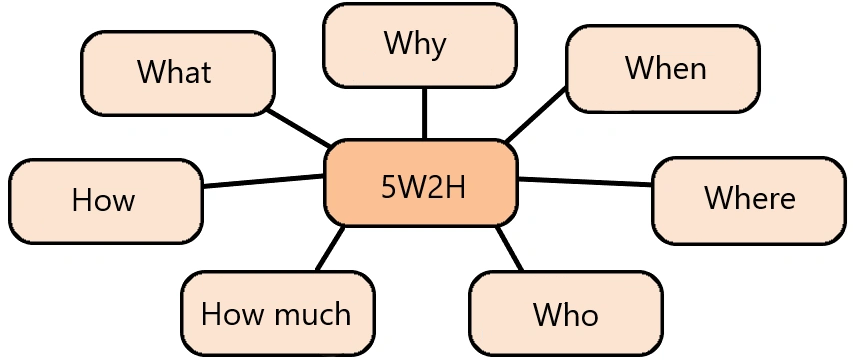
Through its 7 explanatory factors, the problem can be visualized in a clear and objective way, favoring the professional's chances of making the most effective decision.
In today's guide, you will understand the importance of making a decision based on the correct interpretation of a problem and the context in which it is inserted, as well as learning the 7 perspectives of 5W2H.
Who created 5W2H?
Of a Japanese origin, it was initially created for management projects by professionals who carried out quality studies, and, currently, it is used in the most varied business projects, such as Lean Six Sigma projects, regardless of their context and operating scenario.
Looking for development in your professional career?
What do you think of becoming a reference professional in the market through one of the most used methodologies in the world?
Our Black Belt training in Lean Six Sigma is the next step towards your growth and recognition!
With our Black Belt certification, you will learn how to manage projects, increase results, lead teams, and the main Lean Six Sigma tools for solving highly complex corporate problems in search of strategic competitiveness.
Don't waste time! Develop the knowledge and skills that will make you a reference professional in the market!

Understand the problem and its importance!
Not only employed in Lean Six Sigma projects, as well as in the most varied business projects, regardless of context and operating scenario, 5W2H is a tool that facilitates the objective and transparent interpretation of the problem and the environment through which it is inserted.
With the problem being understood from different points of view, decision-makers can analyze which decisions are most cost-effective to take, so that the end result is the best and most coherent possible with the stated objective in the project scope.
It is only by understanding the problem efficiently that it is possible to act on it and obtain as a consequence an effective result.
How to apply the 5W2H?
The 5W2H can be applied in a simple Excel worksheet as a means of facilitating to those involved a clear and precise understanding of the problem they are seeking to solve.
In the image below, you can see a suggestion of a 5W2H model.
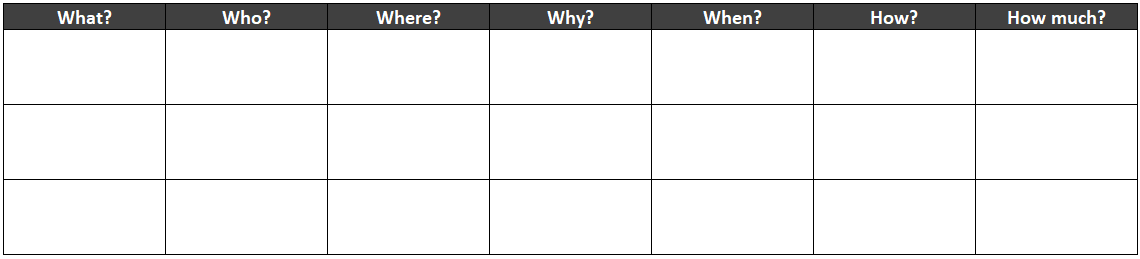
Now you will check out what each of these 7 factors means. Let’s go?
- What: should be noted here the description of what the problem is about, the purpose of the project and / or the improvement goal being proposed to achieve;
- Who: who is responsible for solving the problem or opportunity for improvement. The team assigned to solve it and who are the internal or external clients are some of the ways to respond this part;
- Where: in this space, the information of the place involved by the problem must be recorded, that is, where it is inserted. It will be defined if it is a specific sector or even in which operation or production machine it operates;
- Why: at this stage it is important to define the reason why solving this problem or reaching the proposed goal is important. Discuss under which financial and qualitative aspects is worth pursuing with the resolution of the problem and / or the achievement of the goal;
- When: the information here is linked in time, that is, from when the problem occurs and what the deadline for resolution, as well as the delivery dates and schedule to meet the project objective;
- How: how it works the process by which the problem is involved is the question to be answered. What steps, activities and relevant variables can affect it. One tip here is to use a flowchart to better represent it;
- How much: here, information can be linked to quantity and cost, that is, how much this problem has already generated expenses for the area involved and / or for the whole company. How much investment is necessary to solve it, as well as how many processes and products it has already affected.
5W2H Example
Here are some simple examples of 5W2H, but that will help you fully understand the application of this amazing tool!
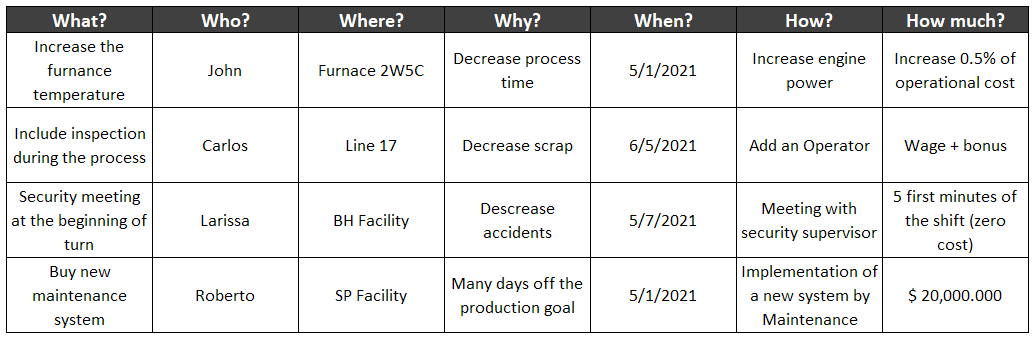
As you can see, with the filling of a table, using this tool, the processes are much more defined, increasing the efficiency of actions and the identification of problems, which can generate a positive impact on productivity and assist in strategic planning. But how does he assist in this? In the following I will explain a little more about the subject.
5W2H in Strategic Planning
In addition to solving problems, 5W2H is also a great tool for creating strategic planning. That's because it defines exactly what the company must do to achieve the stipulated goals.
After all, it is not enough to know where you want to go, you need to define the path that will be followed to get there. This is exactly what the 5W2H provides: the definition of the means for the objectives.
As an example, one of the fundamentals of Lean Six Sigma is to make decisions based on facts and data that indicate exactly and precisely the best way to go.
And, in order to achieve goals, it is essential to know very well all the different perspectives of the context involved in each decision, isn't it?
For many times we face complex and difficult problems to be eliminated. Thus, it is necessary to investigate the causes of the problem and eliminate them so that the processes can function again in the best possible way, and a tool that can be used for this purpose is the 5W2H.
Everyday Life 5W2H
5W2H allows us to improve the planning of not only companies or complex projects, but also our daily activities. We are often faced with so many tasks that it is difficult to know where to start, is it not?
Thus, we can use 5W2h to direct processes and actions in an organized way.
This way, it is much easier to manage to do everything, when we create a good plan, be it in professional life or, even, in personal life.
Other problem-solving tools
5W2H is not the only tool used for structuring actions and identifying problems, it can be used in conjunction with other tools to improve processes. Some of these tools are:
- Brainstorming: technique that brings a team together to form a "brainstorming" about a topic. When you want to solve a problem, it is interesting to consider different points of view with everyone involved in the situation. Brainstorming appears as an opportunity to achieve just that. From it, several ideas about what may be causing the problem are raised, which facilitates the solution process. It is a great option, as it quickly provides a large number of ideas, stimulates creativity, promotes the engagement of participants and generates "input" for other tools.
- Ishikawa Diagram (Fishbone Diagram): it is a tool used to present the relationship between cause and effect of the process that, for technical reasons, may affect the result considered. Often, the outcome of interest to the process is a problem to be solved.
- 5 whys: this is a simple problem-solving method, which consists of asking the question "Why" five times to understand the cause of the problem. This technique is widely used for simpler problems, with direct causes. It can be applied at any time, without the need for statistical analysis and the team responsible for the process is able to use it, generating very positive results.
Do you want to learn more?
Continue to specialize in the Lean Six Sigma methodology and take the next step for your professional recognition now! With the advancement of tools and techniques from Green Belt to Black Belt you will be able to delve even deeper into this methodology, offer greater results to organizations, consequently being a prominent professional in the market!