What is Lead Time? Learn about its importance!
Understand what Lead Time means, a very important concept in Lean Manufacturing methodology.


Before you talk about the concept of Lead Time, let me ask you a question: Do you like waiting? The answer certainly is no, right? Even more in this technological and instant world we live in, where 10 seconds seem like an eternity. Don't you get pissed off when someone takes an eternity to answer you on WhatsApp?
When the arrival of a message is delayed, what happens is that you will only have a delay in communication and see what the reality was like before the instant messengers.
But when we deal with production processes, the longer the production cycle lasts, the less productive this cycle will be, and this leads to huge expenditure that could be avoided.
In a production line, time is money! Any reduction in Lead Time results directly in cost reduction, which in turn leads to increased profits.
Lead Time is one of the key concepts and metrics of Lean Manufacturing, coming from the Toyota Production System, being the main point on which this methodology is supported.
What is Lead Time?
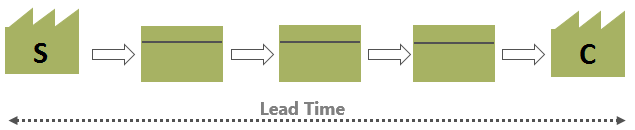
By definition, Lead Time is the time it takes for a product or service to go through all process steps or value flow from start to finish.
Generally, Lead Time is the time elapsed since the customer makes a request for a product or service until the customer receives the product or the end of the service.
The term Lead Time comes from the combination of Lead and Time, i.e. the time it takes the entire process through the production cycle. Hence comes the basic definition as the "waiting time" of the cycle.
How to calculate Lead Time?
Now you know what Lead Time is, you may be wondering: how do I calculate this? To perform this calculation, you must follow the following steps:
- List the raw materials (items) that are required to produce the product;
- List the delivery time of each item;
- Identify the item with the longest delivery date;
- Establish the number of days/hours that are necessary for the production and delivery of the product, also considering the time spent in administrative tasks;
- Lead Time will be the sum of the acquisition time of the raw material with the time of production and delivery of the product.
When we talk about continuous improvement projects, we have several stages that are susceptible to errors. Thinking about it, we developed the Ebook The most common errors in the Six Sigma Implementation, so you know how to prevent and avoid failures at every step of your project!
Download this material now, and see how to avoid and act on the possible failures of Lean Six Sigma projects!
![[EBOOK] The Most Commom Errors In The Six Sigma Implementation](https://files.voitto.com.br/blog/prismic/46b5c02e-4e5e919a-9b4d-4fcf-b630-d5979c11741c_Bot_o_Banner_Cursos_-_TLSS_12_.png "[EBOOK] The Most Commom Errors In The Six Sigma Implementation")
The Critical Path Method to calculate the lead time
The Critical Path Method is based on the identification of the sequence of activities (critical) from the receipt of the service order to the delivery of the product to the customer, in which if there is a delay, the delivery deadline will be compromised , that is, the Lead Time will be the sum of the time of the activities in the critical path.
To facilitate your understanding, I will demonstrate the calculation of Lead Time through an example:
The company Voitto Bikes, manufactures sports bicycles. The Production Manager wants to calculate the Lead Time of production of the bikes from the moment an order was made. The sequencing of the production activities is known, as well as the time of acquisition of the materials and of the production spent in each activity.
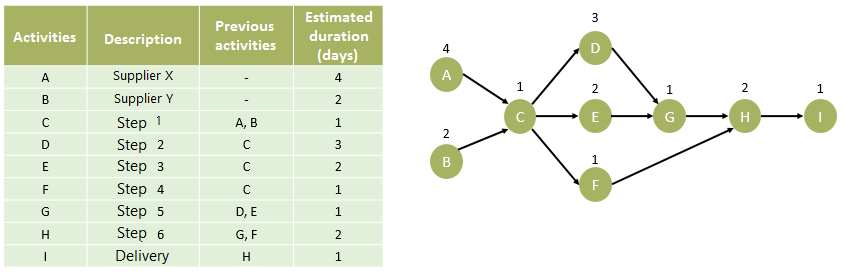
Now, just identify the critical path and calculate the Lead Time:

You can conclude that Lead Time in this example is 12 days.
How to improve lead time?
This is the question that Taiichi Ohno, the person largely responsible for creating the Toyota Production System and a world reference in Lean Manufacturing, proposed to answer precisely through the production model he decided to implement in his factories.
Taiichi wanted to implement a lean production, with the shortest lead time possible. For that, he focused on a solution: eliminating waste!
But what kind of waste? No more, no less than eight types! These are: transport, inventory, movement, waiting, knowledge, overproduction, overprocessing and defects.
In addition, the lean model also used production leveling and Lean tools to further shorten lead time.
This is because Japan was going through a phase of restructuring after the war and needed to gain competitive advantages, so that domestic companies could return to growth.
There is nothing better for this than reducing lead time, as this reduces production costs, makes it possible to launch products at lower prices and increase the company's profits. All this using Lean Manufacturing!
Why is lead time important in running a business?
Understanding the importance of Lead Time is essential for the phases of a product to be analyzed more carefully.
From this analysis, future problems can be reduced, especially if strategic actions are taken by the responsible professionals.
In this way, the provisioning time and delivery time of the product or service is significantly reduced.
Below we will present some of the main benefits of a well done Lead Time!
Improve processes
When the company is able to control its Lead Time, the internal management related to processes tends to improve as it becomes possible to analyze each step, understanding all the strengths and improvement points.
From this analysis, action plans are created to make the company increasingly productive.
Avoid losses
Consumers prioritize products that are delivered quickly and with quality, especially in the era we live in, where competition is increasing.
A good delivery is a decisive factor for an individual to buy your product or opt for the competition. Keeping this agility can prevent losses or loss of potential customers, so the lead time must be constantly optimized.
Increase productivity
Increasing productivity in a company is directly related to Lead Time. When internal processes are standardized and there is good logistics, it is possible to create a more dynamic and productive work environment.
With that, comes a series of benefits, such as building more agile teams, saving time that reflect on the quality of the final product.
Want to learn more about Lean Manufacturing ?
Taking advantage, we took the liberty of separating a complete ebook on Lean that will explain everything you would like to know about this methodology, with the ebook - Lean Manufacturing from A to Z you get ahead. With this e-book, you will learn:
• The 8 types of waste;
• Lean metrics;
• Improvement tools;
• The role of leadership in the implementation of Lean Manufacturing;
• How to adopt the Lean in your company;
• The main barriers to implementation.
Do not miss this opportunity and download this material now!
It's time for you to start your training in one of the most valued methodologies on the market!
With our Green Belt training in Lean Six Sigma, you will develop fundamental skills and knowledge for your professional growth!
Our teaching methodology has content such as videos, exercises, complementary readings and personal assistance, so you can take the next step towards Green Belt professional recognition in Lean Six Sigma.
Don't waste time and reach the next level in your professional career!